
When a Red Traffic Light Turns into a Health & Safety Lesson
Health and Safety isn’t core HR, but it is something we get asked about surprisingly often.
While on our way to visit a client, my colleague Ale and I had a moment that reminded me exactly why it matters.
We were sitting at a red light when we witnessed something quite extraordinary.
An Impressive (and Slightly Terrifying) Display of Skill
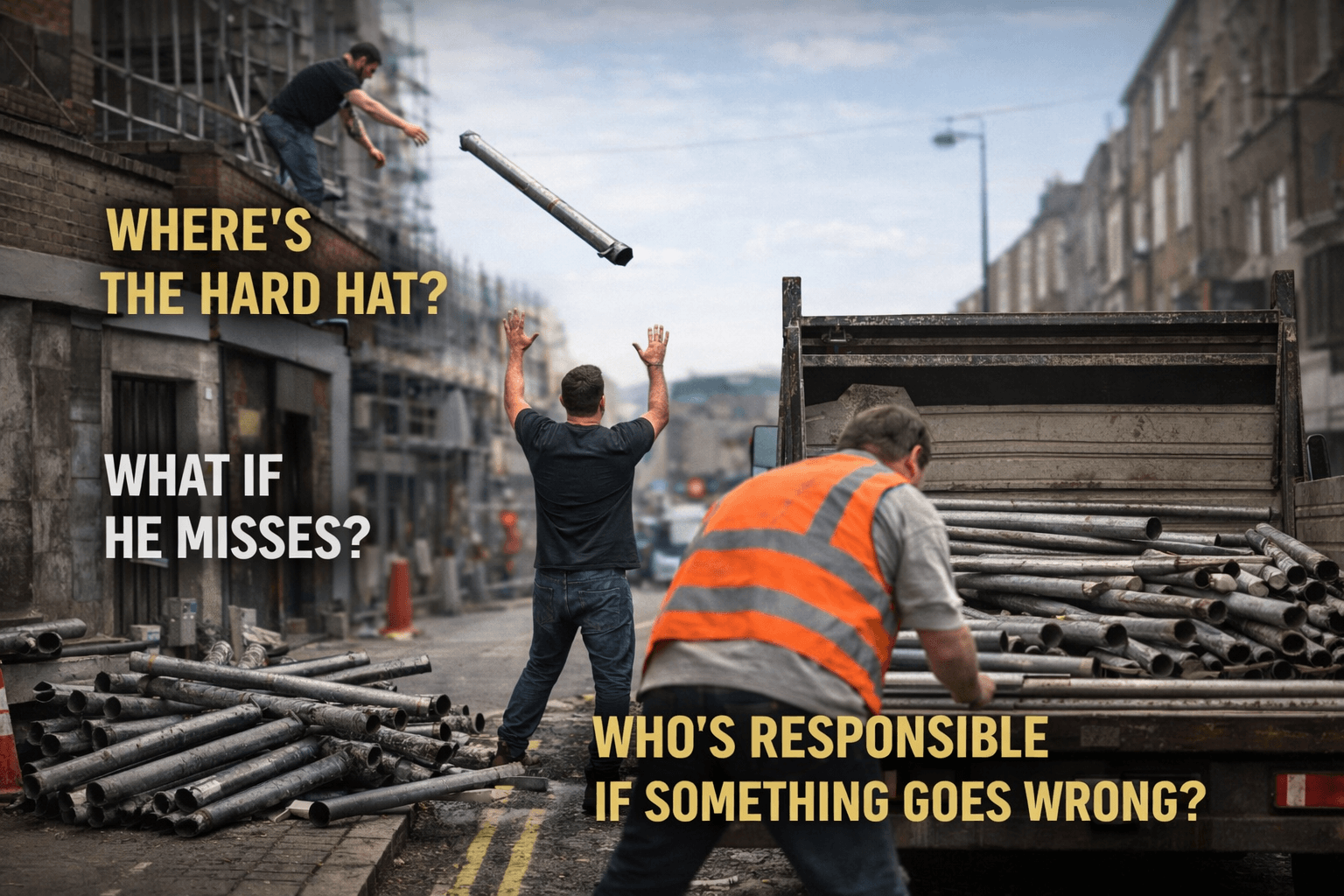
On the roof of a building stood man number one, throwing scaffolding poles down to the pavement below.
Waiting beneath him was man number two, catching the poles as they fell. Not gently receiving them. Catching them mid-air with remarkable precision.
Moving between them was man number three, collecting the poles from the pile that had formed and stacking them neatly into the back of a lorry.
It was almost like watching a well-rehearsed performance.
Their coordination was impressive.
Their timing was spot on.
Their skill was undeniable.
Ale and I both looked at each other with the same initial thought:
That’s incredible.
But, as often happens with those of us who work in HR, the next thoughts quickly followed.
When the HR Brain Kicks In
The first question that popped into my head was simple:
Where are their hard hats?
Then the next thought: What happens if man number two misses the pole?
And another: What happens if man number three, who didn’t seem to be watching quite as carefully, gets hit by a falling pole?
And surely, this cannot possibly be the standard operating procedure for dismantling scaffolding from a building.
That’s when the questions started to shift from curiosity to concern.
- Have these workers been properly trained?
- Is there a documented safe working procedure?
- Has a risk assessment been carried out?
- Would their employer be able to defend an injury-at-work claim if something went wrong?
And then one final, much more serious thought.
If a metal scaffolding pole was thrown from ten metres above and someone was seriously injured, or worse, what would the consequences be for the employer?
Would their insurance cover them?
Or could they be facing something far more serious, such as a corporate manslaughter investigation?Health & Safety Is Not Just for Construction Sites
It’s easy to assume Health and Safety is primarily an issue for construction companies or manufacturing environments.
But the reality is that every employer has a legal duty of care.
Regardless of the size of your organisation, if you employ people you are responsible for protecting both their physical and psychological health and safety.
That responsibility doesn’t disappear just because your workplace looks “low risk”.
In fact, many of the Health and Safety questions we deal with come from businesses that operate in offices, shops or professional environments.
Health & Safety Comes in Many Forms
When people hear the words “Health and Safety”, they often think of hard hats and high-visibility jackets.
But in reality, it covers a much broader range of responsibilities.
For example:
- Workplace risk assessments
- Pregnancy risk assessments
- Working from home assessments
- Manual handling training
- Display screen equipment assessments
- Personal protective equipment (PPE)
- Workplace stress and mental health considerations
- Safe systems of work
All of these are part of an employer’s duty to identify potential risks and take reasonable steps to reduce them.
It’s not about creating paperwork for the sake of it.
It’s about thinking ahead and asking a simple question:
“What could go wrong, and what can we do to prevent it?”
Policies and Paperwork Are Only Part of the Story
One of the most common issues we see is businesses that technically have Health and Safety policies in place is that they aren’t actually embedded in day-to-day working practices.
Having a policy is important.
But it’s only effective if:
- Staff are properly trained
- Procedures are documented and understood
- Standards are consistently enforced
- Risks are reviewed regularly
Health and Safety is not a one-off exercise. It’s something that needs to be part of the culture of the organisation. Because when something does go wrong, the question investigators often ask is not just “Did you have a policy?” but also “Did you actually follow it?”
Protecting Your People and Your Business
Ultimately, Health and Safety is about protecting people. But it’s also about protecting your business.
Failing to manage risks properly can lead to:
- Serious injuries
- Legal claims
- Regulatory investigations
- Invalidated insurance
- Reputational damage
- Significant financial penalties
In extreme cases, it can even lead to criminal prosecution.
Which is why taking a proactive approach to Health and Safety isn’t just good practice, it’s essential leadership.
A Simple Reminder for Employers
That moment at the traffic lights lasted less than a minute.
But it served as a powerful reminder that unsafe working practices can sometimes become normalised, particularly when people are skilled and experienced.
The problem is that skill does not eliminate risk.
And it only takes one mistake, one distraction or one misjudged moment for something to go badly wrong.
Regardless of the size of your organisation, if you employ people you are responsible for their safety and wellbeing at work.
That means thinking about risk assessments, training, policies and safe systems of work.
Not because the law says you must. But because the people who work for you deserve to go home safely at the end of the day.